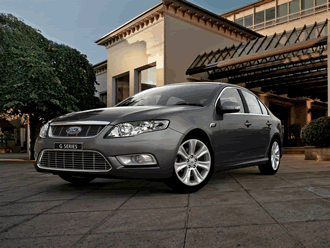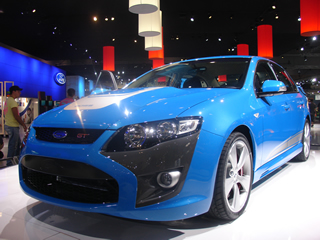
Today’s launch of the all new Ford Falcon FG series has been one the most anticipated releases in Australian motoring history. It is hoped the new model range will help boost the large car market in Australia which has been suffering from dropping sales over the past few years. The new FG Falcon comes in a range of models including a new G series which is the luxury flagship for the model. The range also features a sporty XR6 with turbo charged six cylinder engine and an aggressive XR8 V8 vehicle. The vehicle comes in two body styles a sedan and a utility vehicle which is sold in both tray and tub form a must for any Aussie tradesman. The all-new FG Falcon offers fuel economy improvements AND increased performance – as well as introducing new passive and active safety features across the range.
See our photospread of the other Falcon FG models.
Ford Australia today unveiled the all-new FG Falcon range, showcasing all-new exterior and interior architectures and designs, an all-new front suspension, new powertrains with more power, more torque and improved fuel economy, and an advanced safety package.
The official debut of the 2008 FG Falcon included the entire new model range, with sedan, Ute and Ford Performance Vehicles line-ups all on show ahead of mainstream sedan models going on sale in May.
The all-new FG Falcon range also introduces a new model line-up and nomenclature, incorporating the new sports luxury G Series sedan range, along with three different exterior front end treatments and a significant realignment of models and specifications.
“The all-new FG Falcon range represents another step forward for automotive vehicle design in Australia,” Ford Australia President Bill Osborne said.
“It is an exceptional large car package that delivers outstanding performance, fuel efficiency, refinement and safety to meet the needs of a wide variety of customers.
“For the first time in Falcon’s history, the new model will come to market with three distinct faces on the vehicle, offering both private and fleet customers, and both sports and luxury customers, a new Falcon to suit their lifestyle.
There are now three families of vehicles in the FG Falcon sedan range, including:
Falcon XT
G Series, incorporating
G6
G6E
G6E Turbo
XR, incorporating
XR6
XR6 Turbo
XR8
“The introduction of the all-new G6E Turbo will create excitement and provide the perfect balance of sports luxury performance for customers who don’t wish to compromise on either sports or luxury options,” Mr Osborne added.
A new body structure for the FG Falcon delivers significant improvements in structural integrity for greater occupant protection, and side and frontal crash performance, as well as improved vehicle refinement.
All petrol Falcon sedans will come standard with an advanced safety package, incorporating driver and front passenger airbags, front side head/thorax airbags, driver and front passenger Beltminder® system, Dynamic Stability Control (DSC), Traction Control (TC), and Anti-lock Brakes (ABS) with Electronic Brakeforce Distribution (EBD) and Emergency Brake Assist (EBA)
Side curtain airbags, in conjunction with front side thorax airbags, are standard on premium sedan models, but are also available as an option across the rest of the sedan range.
A new reverse camera system is standard on G6E and G6E Turbo models, and optional on the overt sports XR range, while a reverse sensing system is standard on all G Series models and available as an option across the rest of the sedan range.
All FG Falcon Utes will have ABS with EBD as standard, while Traction Control is standard on XR Utes and optional on the remainder of the Falcon Ute line-up.
New model line-up
The new ‘FG’ series prefix for the eighth generation Falcon range heralds the arrival of the all-new Falcon line-up, as well as serving as an acknowledgement of the strong heritage of the long-running Fairmont and Ghia nameplates.
That acknowledgement also translates to the introduction of the new sports luxury G Series sedan range, incorporating the G6, G6E and G6E Turbo models.
The G6 is a nod to the “Ghia” nameplate and an extension of the G8 nomenclature used on the outgoing Fairlane range in recent years, while the “6″ represents Falcon’s high-tech six-cylinder engine.
G6E builds on the nod to “Ghia” and is a modest acknowledgement of the European-inspired styling and distinct design cues evident in the new vehicle, while G6E Turbo announces the introduction of the acclaimed I6 Turbo engine as the new hero of the sports luxury line-up.
Falcon XT
With a focus on interior appointments and safety features, the Falcon XT raises the bar for entry-level vehicle private customers and fleet buyers. For the first time on Falcon, it will have its own appearance and be distinctly different from the rest of the range.
The XT comes with the choice of either an I6 petrol engine producing 195kW of power and 391Nm of torque matched to a new five-speed automatic transmission with Sequential Sports Shift (SSS), or an optional 156kW E-Gas dedicated LPG engine with a four-speed SSS auto. The ZF six-speed automatic transmission is available as an option on the I6 petrol engine.
Standard interior appointments include automatic climate control, four-way power driver’s seat, four-speaker single CD audio system, a new, larger Interior Command Centre (ICC) LCD screen, cruise control and 60/40 split fold rear seats.
Dynamic Stability Control (DSC) is standard on all petrol models, while the XT also features driver and front passenger airbags, front side head/thorax airbags, and a driver and front passenger Beltminder® system.
G6
The entry G Series model, the G6 raises the bar for the discerning luxury buyer with a range of standard features in addition to those on the Falcon XT. These include a unique G Series front bumper and grille, front fog lamps and 17-inch alloy wheels, along with luxury interior appointments, including suede seat bolsters and a rear centre armrest with cup holders. The G6 also incorporates luxury sports suspension and, on the safety front, a reverse sensing system as standard equipment.
G6E
The G6E builds upon the luxury G Series story even further, adding to the standard G6 specification with a range of features to deliver a highly-specified luxury G Series variant. Standard G6E features include the acclaimed ZF six-speed automatic transmission, along with a side indicator integrated into the exterior mirror housing, a front fender badge, unique 17-inch alloy wheels and a unique G6E front grille.
The interior adds a Bluetooth® mobile phone integration module, a premium audio system with seven-inch TFT colour ICC screen, six-disc in-dash CD player and subwoofer, an electrochromatic rear vision mirror, dual-zone automatic climate control, leather seats and an eight-way power driver’s seat with three-position memory. On the safety front, the G6E adds a reverse camera and side curtain airbags as standard equipment.
G6E Turbo
The new hero of the sports luxury Falcon line-up, the G6E Turbo is differentiated from the G6E by a range of performance-oriented features, including the I6 Turbo engine that produces 270kW of power and 533Nm of torque, matched to the ZF six-speed automatic transmission. New 18-inch alloy wheels, a rear lip spoiler and bright headlamp bezels complete the unique exterior elements, while 19-inch alloy wheels are available as an option.
Interior differentiation includes fabric-wrapped lower door trims and an iPod Integration feature, which provides a fully integrated interface between a customer’s iPod unit and the vehicle’s audio system.
Falcon XR6
The FG Falcon XR range continues to build on the powerful and distinctive design cues that have contributed to the cult status enjoyed by XR vehicles. The XR6 incorporates a host of features over and above the Falcon XT, including a new Tremec six-speed manual transmission as standard – with the option of either the five-speed automatic or the ZF six-speed automatic transmissions – and sports suspension.
The exterior is differentiated by the signature XR double-drop lens headlight treatment, XR front bumper, grille and rockers, front fog lamps and unique 17-inch alloy wheels. Inside, the XR6 features a sports instrument cluster, sports seats, alloy pedal covers and an aluminium gear shifter on manual transmission models, with reverse camera and reverse sensing systems available as options.
Falcon XR6 Turbo
In recognition of its overt sports status, the XR6 Turbo will – for the first time – be specified to the same level as the XR8, with the main difference between the two models being the engines.
The FG Falcon XR6 Turbo builds on the equipment levels of the XR6 with a range of performance and comfort-oriented features, including a 270 kW / 533 Nm I6 Turbo engine, limited slip differential, upgraded front brakes and 18-inch alloy wheels. The world-class ZF six-speed automatic transmission is available as an option.
Falcon XR8
The XR8 shares its major equipment specifications with the XR6 Turbo and is differentiated by its engine and signature bonnet power bulge. The exciting Boss 290 5.4-litre four-valve V8 engine moves to the XR8 with the introduction of the FG Falcon and is complemented by a new exhaust system with a Semi Active Muffler (SAM). The new exhaust system produces an unsurpassed, sporty V8 exhaust note, while also delivering a more refined interior environment.
A bold 19-inch five-spoke alloy wheel design is available as an option on all XR models.
Falcon Ute
The all-new FG Falcon Ute will go on sale shortly after the mainstream sedan range, offering no compromise performance and functionality, with the ideal mix of truck-like capability and car-like comfort, driveability and safety.
Each model in the new Falcon Ute range represents a unique mix of workhorse and recreational elements, which ensures the job gets done during the workday week, as well as on weekends when its time to getaway.
Falcon Ute
The entry level model, Falcon Ute is available in either Cab Chassis or Styleside Box bodystyles with a choice of engines and transmissions.
Standard powertrain specification is the I6 petrol engine, producing 195kW of power and 391Nm of torque, matched to a new six-speed manual transmission, while the new five-speed automatic transmission with Sequential Sports Shift (SSS) is available as an option. Also optional is the E-Gas dedicated LPG engine, which is matched with the proven four-speed automatic transmission with SSS.
Other features include cloth trim, a single CD audio system with a new, larger Interior Command Centre (ICC) LCD screen, cruise control, four-way power driver’s seat, power mirrors and windows, and steering wheel mounted controls for the audio and cruise control systems.
Safety items include driver and passenger airbags, driver and passenger Beltminder® system, and ABS with EBD, while side head/thorax airbags are available as part of an optional Safety Pack that also includes a perimeter alarm system.
R6
The new R6 model introduces an all-new model name to the FG Falcon Ute range, with a host of key sports features that deliver an altogether sportier look, feel and drive, as well as close links to the overt sports XR line-up.
With sports suspension, front fog lamps, 16-inch alloy wheels, XR rockers and rear bumper, and a new, flush-fitting tonneau cover (on the Styleside Box model), the new R6 offers a fresh combination of sports ute dynamism with renowned workhorse capabilities.
On the inside, the R6 features sports bucket seats with unique seat trim, passenger seat lumbar adjustment and a leather-wrapped steering wheel.
XR6
The XR6 builds on the specification and equipment of the new R6 model while still offering a wide choice of bodystyles – Cab Chassis and Styleside Box – and powertrains – I6 petrol with six-speed manual or five speed automatic transmissions, or I6 E-Gas with four speed automatic transmission.
The exterior is differentiated by the signature XR double-drop lens headlight treatment, XR front bumper and grille, front fog lamps and unique 17-inch alloy wheels, while Traction Control (TC) adds to the list of standard equipment.
Inside, the XR6 features a sports instrument cluster, sports seats, alloy pedal covers and an aluminium gear shifter on manual transmission models, along with automatic climate control and a sports leather steering wheel. Bluetooth mobile phone integration, iPod Integration and 18-inch alloy wheels are available as part of an optional XR Sports Pack.
XR6 Turbo
Like its sedan cousin, the XR6 Turbo Ute will – for the first time – be specified to the same level as the XR8, with the main difference between the two models being the engines.
The FG Falcon XR6 Turbo Ute builds on the equipment levels of the XR6 with a range of performance and comfort-oriented features, including a 270 kW / 533 Nm I6 Turbo engine, limited slip differential, upgraded front brakes and 18-inch alloy wheels. The world-class ZF six-speed automatic transmission is available as an option.
XR8
The XR8 shares its major equipment specifications with the XR6 Turbo and is differentiated by its engine, the exciting Boss 290 5.4-litre four-valve V8, and signature bonnet power bulge.
A bold 19-inch five-spoke alloy wheel design is available as a stand alone option on all XR Ute models or as part of the XR Luxury Pack, which also includes premium sports interior, leather seat trim, premium audio system and dual zone climate control.
The Bluetooth® word mark and logos are registered trademarks owned by Bluetooth SIG, Inc. and any use of such marks by Ford Motor Company is under license.
iPod is a trademark of Apple Inc.
February 17th, 2008

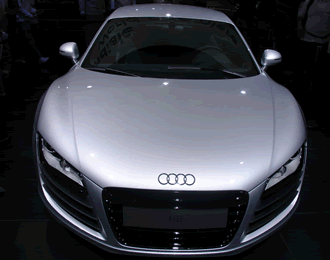
In a motoring first Audi has shown its R8 V12 supercar in turbo diesel form. The engine pumps out a whopping 500hp with 1000 nm of torque. Using an engine closely releated to the Audi R10 Le Mans winning vehicles the car is a true super car. Top speed is well over 300 kph and it can do 0-100 in 4.2 seconds. The engine was built at the Gyor plant in Hungary nd it looks that the TDI V12 will go into production for this amazing vehicle. The engine already fulfills all the Euro 6 emission standards which wont be in effect until 2014. One intresting styling feature on the vehicle is red illuminated LED’s in the engine bay so the engine can be seen through the window all lit up at night. How cool is that!
For more Information:
Audi official press release for the R8 V12 TDI
Audi is presenting a revolution in the top class at the Detroit Auto Show 2008 – the first 12-cylinder diesel engine in a high-performance roadgoing sports car. The V12 TDI with a displacement of six liters powers a concept car based on the Audi R8. This unit generates a huge 500 hp and 1,000 Newton-meters (737.56 lb-ft) of torque. Audi is writing a new chapter in diesel technology with this power unit. Equipped with the expertise that Audi has built up through its motor sport activities, the R8 V12 TDI in matt “Grace Silver” embodies superb road handling, pioneering technology and fascinating design.
The V12 TDI is closely related to the engine in the Audi R10, the two-time Le Mans winner – so it catapults the Audi R8 into supercar terrain concerning performance too. It sprints from zero to 100 km/h (62.14 mph) in just 4.2 seconds and its top speed is well over 300 km/h (186.41 mph). The peak torque, reached at only 1,750 rpm, paves the way for effortless acceleration that is unrivaled even at this level.
The new V12 TDI belongs to Audi’s family of V engines but has the ideal included angle for this engine type of 60 degrees between cylinder banks. Its highlights include the new chain drive layout that includes the two newly developed high-pressure pumps for the common rail injection system.
Its sound is as thrilling as you’d expect in a sports car of this caliber. For all the subtle smoothness that typifies this design principle, the twelve-cylinder unit is full-bodied and equipped with energetic overtones that make no secret of its performance potential.
The Genes of the Winner
Thanks to their high performance and pulling power, all Audi TDI engines are ultra-dynamic sources of power. The brand has often enough demonstrated its sporty character in its production cars, especially the six- and eight-cylinder 3.0 TDI and 4.2 TDI. Audi has also been writing a new chapter in its success story on the racetrack since 2006. The diesel engine in the R10 sports prototype won its very first endurance race at Sebring, Florida, when it was pitted against an entire field of gasoline-engined challengers. But its most crucial victories were surely in 2006 and 2007 in the 24 Hours of Le Mans, when it simply outclassed the international elite.
The V12 TDI race engine in the R10 produces over 650 hp from a displacement of 5.5 liters, giving it the potential for a top speed as high as 330 km/h (205.05 mph) depending on the gear ratios. Its power and sturdiness immediately impressed both fans and experts, who were impressed by its restrained noise level. Unusual for a race engine, this powerful Audi diesel makes barely more than a whisper.
Long traditions of motor racing and production technology complement each other at Audi. The FSI engine of the R10′s predecessor, the R8, captured five wins at Le Mans with a direct gasoline injection system. Audi is also looking to maximize the advantage by using the race-tested FSI principle in its production models. The latest examples of this are the V8 with high-revving concept in the RS 4 and the production version of the Audi R8.
The Drivetrain
The roadgoing version of the new V12 TDI is built at the Györ plant, in Hungary. And the R8 V12 TDI still has a massive 500 hp on tap. In developing the six-liter engine, it was a clear priority to integrate it into the current family of Audi V engines, of which many thousands of versions with 6, 8 and 10 cylinders have already been built – both gasoline and TDI.
Audi’s engineers were in an ideal position to use their experience building the racing engine to develop the road version. Like the other power units in this range, the distance between cylinder bore axes on the V12 TDI is 90 mm (3.54 in.). Yet its included angle is 60 degrees, not 90 degrees. This means no free inertial forces or mass moments of inertia can occur with the V12. The results are refined in every respect.
The 83.0 mm (3.27 in.) bore and 91.4 mm (3.60 in.) stroke produce a total displacement of 5,934 cc – just like the 3.0 TDI. At only 684 mm (26.93 in.) long, this large diesel engine is very compact and just 166 mm (6.54 in.) longer than the V8 TDI. This compact length is key to accommodating the V12 in the mid-engined Audi R8.
The V12 TDI crankcase is made from gray cast iron with vermicular graphite – a high-tech material referred to as GJV-450 that is already used on the V6 and V8 TDI engines. GJV-450, made by a patented casting process, is about 40 percent more rigid and 100 percent more fatigue-resistant than gray cast iron. This enabled the developers to make its walls thinner, cutting its weight by around 15 percent compared with conventional gray cast iron.
The two cylinder heads are each made from three main elements. These are a base section made from a high-strength aluminum alloy incorporating the intake and exhaust ports, an oil-bearing upper section, and a reinforcing ladder frame supporting the two camshafts.
The valves are actuated by low-friction roller cam followers; the compression ratio is 16.0:1. Map-controlled swirl variation of the combustion air has been adopted from the V6 and V8 TDI engines. This produces permanently optimized swirl concerning both emissions and high performance.
Ultramodern Injection Technology
As is the case in the Audi V engines, the no-maintenance chain drive is mounted at the back of the engine, where it occupies little space. Its layout has changed on the new V12 TDI. The camshafts’ sprocket engages in an intermediate gear via which two Simplex chains drive the camshafts. Two more chains drive the oil pump and the two high-pressure pumps actuate the common rail injection system.
The two new dual-piston high-pressure pumps form part of the common rail injection system supplied by specialty manufacturer Bosch. The two pumps build up a pressure of up to 2,000 bar in the rails. The piezo injectors with eight-hole nozzles have also been fundamentally revised.
The high pressure distributes the mixture optimally throughout the combustion chamber. The result is that the ignition process is faster, more homogeneous and more acoustically refined. The more efficient combustion process also increases power output, cuts consumption and reduces pollutant emissions.
The current generation of so-called inline injectors makes effective use of the piezo effect: piezo crystals expand in a fraction of a millisecond when an electrical voltage is applied. The number of injection processes per operating cycle can be varied across a wide range thanks to piezo technology – reaching as many as five fuel injection operations in the case of the V12 TDI.
As well as the main injection, pilot and post injections are possible. Pilot injections tone down the acoustic harshness of the combustion process. Retarded post injections are designed specifically to increase the temperature of the exhaust gas, promoting regeneration of the two standard particulate filters.
The two turbochargers are located on the outside of the engine’s V, each of them supplying one bank of cylinders. Thanks to their variable turbine geometry, the full flow of exhaust gas always passes through the turbine, so the chargers respond slickly – even at low engine speeds – and operate very efficiently.
The two turbochargers, which generate up to 2.6 bar of boost pressure, play a crucial role in producing the huge torque of 1,000 Nm (737.56 lb-ft) that the V12 TDI maintains from 1,750 rpm to 3,000 rpm. In developing 368 kW (500 hp), the diesel achieves a specific output of 62.0 kW (84.3 hp) per liter displacement.
Two large intercoolers reduce the temperature of the compressed air. The V12 has a twin-pipe exhaust system with two particulate filters. The intake system is similar in structure with one air cleaner per cylinder bank, with an airflow meter behind it. Two control units, sharing the workload in a master/slave principle, manage events in the engine.
The Audi R8 V12 TDI concept already fulfills the Euro 6 emissions standard that is likely to take effect in 2014 and calls for sharply reduced nitrogen oxides. By also designing in ultra-precise fuel metering by the common rail system, Audi’s engineers have made full use of current clean diesel technology.
The heart of the system is a special catalytic converter downstream of the oxidizing catalyst and the particulate filter. The second component in the system is an additional tank containing an aqueous urea solution. Small quantities of the solution, known as “AdBlue,” are injected into the exhaust system. The hot exhaust gases break the solution down to form ammonia that splits the nitric oxides into nitrogen and water. The system remains effective for the entire service life of the vehicle.
The dynamic character of a sports car depends not just on its performance and torque; the transmission ratios have to be right too. In keeping with the character of a high-performance sports car with unbeatable torque potential, the transmission in the R8 V12 TDI has six manually operated gears.
The manual transmission is very compact in design. Together with the small-diameter double-plate clutch, this means it can be installed low down. The manual transmission has very short shift travel and utterly precise guiding of the shifter into the open gear lever gate. It is made from polished aluminum, has an agreeable feel and exquisite sports car looks.
Such a high-performance Audi also has quattro permanent all-wheel drive. In the case of this mid-engine sports car, power is distributed variably between the front and rear wheels from a starting ratio of 40:60 to optimize the handling.
The Design
The R8 V12 TDI concept with matt “Grace Silver” bodywork looks even wider and more resolute than the core model. It shows its potential through its muscular proportions, accentuated wheel arches and even larger air apertures. The rhombus-pattern cover on the air inlets and outlets is the hallmark of Audi’s sporty top models and a familiar feature of the current RS generation.
Typical of the side view of the R8 is the sideblade. Much wider in the bottom third, it visually accentuates the engine’s position as well as acting as an enlarged air deflector.
The continuous aluminum spoiler lip that connects the front and rear diffusers with side air baffles below the enlarged sills also pays tribute to this version’s highly developed dynamic talents.
And yet the R8 is unmistakable for its powerful, elegant basic proportions. The selective but always precise use of lines is another typical Audi characteristic, as is the curved arc of the roof. One new aspect is the glass roof of the passenger compartment with two large transparent sections. These, together with the glazed engine compartment behind, create a radically new formal element. The unmistakable NACA duct in the middle of the roof is a functional detail that is normally reserved for racing cars. Its ingenious shape accelerates the air drawn in here for the two cylinder banks of the V12 TDI engine.
The V12 TDI is displayed as the beating heart of this sports car, like a work of art inside a large showcase. Its look, underscored by the air deflectors located beneath the restyled rear glass lid, differs clearly from its production counterpart. The engine can even be seen after dark, when white light-emitting diodes illuminate the engine compartment – as on the production R8 version. This “showroom” can additionally be fully lined in genuine carbon fiber, for a particularly exclusive look.
The continuous line running from the front apron across the wheel arches and flanks to the tail end, then back down the other side, is one of the latest design hallmarks of the Audi brand. This “loop” naturally encompasses the air apertures, the headlights and the taillights.
Unmistakable Face by Day and Night
The passion expressed through the elaborate design of the lights is another typical Audi trait. Nor is anyone likely to overlook this Audi sports car from behind: the LED taillights have a three-dimensional look that can’t be missed.
But the absolute highlight is the all-LED headlights of the study vehicle. With their lenses and reflectors, not only do these innovative light sources have a ground-breaking appearance, they also have an enormous functional advantage: LED light, with its color temperature of 6,000 Kelvin, resembles daylight much more closely than xenon or even halogen light. Better light means the driver will have much less fatigue when driving at night.
Ergonomic and Elegant
The interior’s design is as sporty and exclusive as the exterior: the characteristic element here is the monoposto – an expansive arc running around the steering wheel and instruments, connecting the driver to the car. The interior consequently picks up on the dynamism of the R8 V12 TDI concept and gives it tactile expression in a form that is accessible the moment you climb in.
The three-spoke sport steering wheel of course remains the focal point of the car’s controls. With a diameter of 365 mm (14.37 in.), it is both sportily compact and ergonomic in shape. The steering wheel rim has a flat lower edge. This is a further aspect of the auto racing feel in the Audi R8 V12 TDI, but one that also brings major functional benefits, facilitating entry and exit for the driver. The steering wheel is covered in fine Valcona leather, with a diecast magnesium core providing strength.
The start/stop button for the engine and the Drive Select switch with the Dynamic/ Sport/Race settings are arranged on the steering wheel. The latter controls the engine and transmission electronics as well as the magnetic ride dampeners in each of three different modes.
In Race mode, the instrument lighting changes from white to red. The navigation system shows a combined display with lap timer and navigation information for the racetrack being driven. Or supplementary information such as centrifugal force and boost pressure can be called up.
Concentrating on the essentials was the priority in the ergonomic arrangement of all Audi R8 versions. The most important consideration – particularly for high-speed driving – is short reach distances for all controls, to keep the time that the driver has only one hand on the steering wheel to a bare minimum. In typical Audi style the monitor is well within the field of view, and the elements of the MMI operating system are located directly below it.
Compared with the production version, the R8 V12 TDI concept’s interior has much larger aluminum applications, especially around the center console. The many carbon fiber elements give the interior a decidedly sporty feel.
The R8′s exceptional everyday practicality for a sports car is maintained in the study vehicle’s spaciousness, even though the longer engine takes up more room. The two occupants have the generous wheelbase of 2.65 meters (8.69 ft.) to thank for the interior comfort. This means the driver and passenger will always be able to find their perfect seated position, whatever their build. The view is also very good for a mid-engine vehicle. Narrow A-posts optimize the field of view to the front and sides.
Light but Highly Rigid Body
The body of a sports car needs to be particularly light and rigid. Low weight permits superior road performance, and rigidity is the crucial starting point for an agile driving feel allied to high precision. The Audi Space Frame body, made from aluminum, provides the ideal basis for this.
Audi has more expertise than any other manufacturer worldwide in the design and production of vehicles based on aluminum technology, and has channeled its accumulated know-how into this area.
The entire bodyshell of the study car weighs just 210 kilograms (462.97 lbs.). In ASF technology, the body’s supporting structure is made of extruded aluminum sections and die-castings. Aluminum panels are incorporated into this skeleton to form a positive connection and perform a load-bearing role. Each individual component of the ASF space frame is optimized for its specific task by the use of widely differing shapes and cross-sections, combining maximum stability with minimal weight. It adds up to a car that’s particularly light and rigid, an outcome that can be felt in the R8’s ultra-precise driving feel.
The aerodynamics experts at Audi have done their work so thoroughly on the study car that, as an added benefit of its elegant shape, the body actually generates downforce – unlike many other sports cars. This aids directional stability at high speeds. It is achieved partly by means of an extending rear spoiler that is much larger than on the production version, and also thanks to the fully clad diffuser underbody.
Two large-format diffuser apertures in the rear bumper demonstrate just how much aerodynamics dictate the shape of the study vehicle. The tailpipes of the exhaust system are located in pairs on the right and left above the diffuser apertures. The add-on, automatically extended rear spoiler also interacts with the air as it flows around the car. The extra downforce it provides increases the efficiency of the air intake generated by the aerodynamic design of the underbody and diffusers. At low speeds, the rear spoiler returns to its initial position.
Chassis
The precision chassis of the Audi R8 V12 TDI concept remains supremely in control of the sporty performance, but is capable of assuring relaxed driving pleasure over long distances too. The sports car is spontaneous and agile at obeying steering movements, always demonstrating exceptionally good driving safety. The suspension, with double wishbones at both the front and rear, is optimized for a neutral self-steering response and maximum ease of control.
The study car, too, has the innovative dampening technology known as Audi magnetic ride. This adapts the chassis characteristic to the profile of the road and the driver’s style within milliseconds.
Ceramic Brakes with Extreme Reserves
A generously dimensioned brake system supplies the necessary braking force. It applies a total of 24 pistons to the four brake disks, combining excellent performance with minimal weight and high durability. The disks are made from carbon fiber reinforced ceramic, a material that has repeatedly proven its worth in the aviation and aerospace sectors. The basis is very hard, frictionally resistant silicon carbide, with its diamond-like crystalline structure. Embedded in it are high-strength carbon fibers that absorb the stresses occurring in the material. The intricate geometry of cooling ducts in the ventilated disks prevents extremely high temperatures. The ceramic brake disk ring is bolted by 10 spring-loaded elements to a stainless steel central element that acts as the connection with the wheel’s hub.
The ceramic brakes are identifiable at a glance by the special red, six-piston monobloc aluminum calipers and the fixed calipers at the rear. The advantages of the ceramic brakes include a further reduction in weight of around 20 kilograms (44.09 lbs.), which in this case improves the handling characteristics and comfort. The high abrasion resistance permits an operating life of up to 300,000 kilometers (186,411 miles). Their key strength, however, is their ability to withstand very high loads. Even on the racetrack, for example, the ceramic brakes always maintain their full reserve performance.
Vorsprung durch Technik: Diesel Milestones from Audi
Audi has reached another milestone in diesel technology with the new V12 TDI. The brand with the four rings has been performing vital pioneering work in this area for the past three decades. Audi premiered the world’s first five-cylinder diesel engine in the Audi 100 in 1978. The first TDI auto engine made its debut in 1989 in the successor model. The 2.5 liter five-cylinder power unit developed 88 kW (120 hp) and 261 Nm, catapulting diesel driving into an entirely new dimension.
This was followed in 1994 by a development version generating 103 kW (140 hp). This engine was optionally available with all-wheel drive – the first TDI quattro model. A new four-cylinder diesel appeared at that time in the Audi 100 and Audi 80, the 1.9 TDI developing 66 kW (90 hp) that has now become legendary.
At the end of 1995 the output of this four-cylinder unit rose to 85 kW (115 hp) with the advent of pump-injector fuel injection. Slightly more than one year later, at the start of 1997, the world’s first 2.5 V6 TDI appeared.
With four valves per cylinder, it achieved an output of 110 kW (150 hp), and its top speed of 220 km/h (136.70 mph) made the Audi A8 the fastest production diesel on the market. The first eight-cylinder TDI followed in 1999 – a V8 engine with a 3.3 liter capacity. The 3.0 TDI made its debut early in 2004 as the first V6 diesel with inline piezo injectors in the common rail system.
The 4.2 liter TDI launched in the A8 in 2005 is currently at the vanguard of Audi’s TDI range. One in three A8 buyers in Germany chose this V8 engine. The next logical step was to make the V8 TDI available in the Audi Q7 in summer 2007.
With extremely clean, ultra-low emission technology, Audi is continuing its tradition of leadership in diesel engine technology. In 1989 it was the Ingolstadt brand that developed direct injection technology. Since then the diesel engine has become around 30 percent more efficient.
The Euro 4 European emission standard has reduced particulate emissions for cars by 93 percent. Long before it came into force, Audi had models on the market that met this standard, even without a particulate filter. And the brand will be offering the world’s cleanest diesel engines in production vehicles in 2008. The TDI engines with the ultra-low emission system will be the first in the world to meet the forthcoming EU 6 emission standard as well as the toughest known statutory limits that apply in the U.S.
Source: Audi AG
January 30th, 2008